


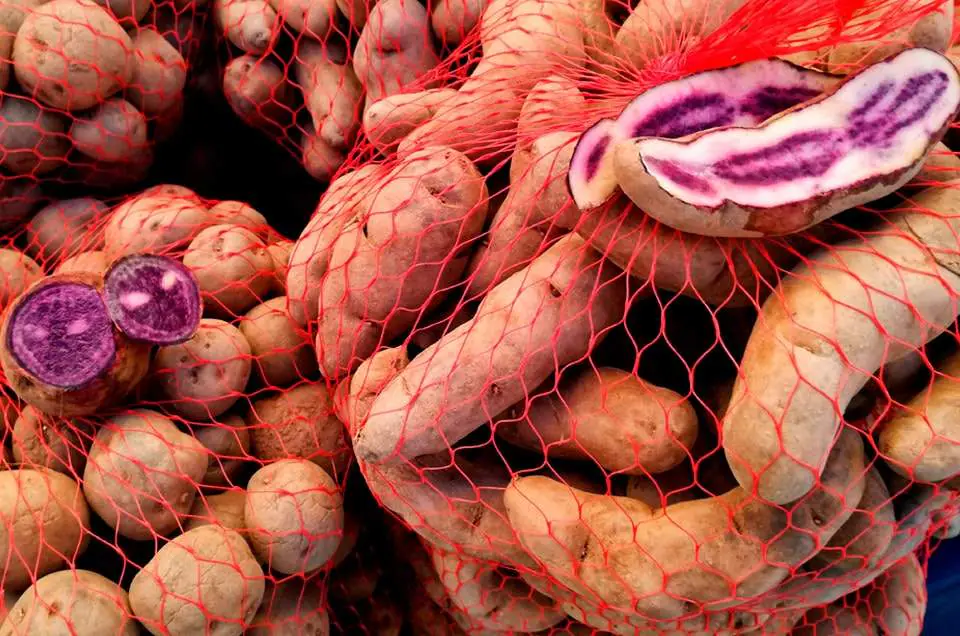
In Peru, besides beautiful attractions and landscapes, there is also plenty of delicious food. This time we focus on the local cuisine, specifically on one of its products: the potato. Anyone of you traveling to South America, including Peru, will have a unique opportunity to taste many unique potato dishes, as well as the potatoes themselves in every color and shape. Why? Below is more about what connects Peru and potatoes 🙂
Peru and potatoes are a must-have combo in South America 🙂
The potato, along with rice, wheat, and corn, is the most important plant in the world, feeding well over a billion people. Where does it come from? So far, all evidence points to the Andes of South America, specifically the territory of the former Inca state of Tahuantinsuyu. Perhaps this theory will change over time, as archaeologists have recently discovered the earliest remains of potato starch in the state of Utah in the United States, dated to about 11,000 years ago. Could it be that the first potatoes appeared there? You can learn more about this discovery in the article here. For now, we still accept the version that South America is the region where these delicious plants originated.
It is believed that potatoes began to be domesticated in the Peruvian Andes about 8,000 years ago. Currently, they are cultivated in over 130 countries. Where is the most potato produced? Unfortunately not in Peru, even though it is the kingdom of potato varieties. Currently, the largest producer of potatoes is China. Poland ranks very well in the global ranking of producers of this plant, much better than Peru, as it is always in the top ten.
There are about 4,000 different varieties of potatoes in the world, most of which are found exclusively in the Andes in Peru. In the entire European Union, 1,247 varieties are available (Community Catalogue of Varieties of Agricultural Plant Species – CCA), while in Poland, 137 are entered in the National Register of Varieties of the Central Center for Research on Cultivated Plant Varieties.
And where is the world's largest potato gene bank? This time Peru can boast, as it is here that the International Potato Center (CIP) was opened. It stores about 13,000 samples of potatoes and other tubers, including: over 4,900 cultivated and wild potato varieties; over 6,500 sweet potato varieties, as well as over 1,300 Andean tuber varieties – such as oca, olluco, arracacha, and yacon.
The fame of the potato is so great that it even has its own holiday. In Peru, Potato Day is celebrated on May 30. In the United States, for a change, World Potato Day is celebrated on October 27.
When did the potato reach Europe?
The Spaniards, who conquered the Incas in 1532, were unaware of the existence of many treasures in the Inca empire, including the nutritional value of potatoes. For this reason, they were not used for food in Europe for a long time. Although they reached European countries shortly after the conquest of Tahuantinsuyo by Francisco Pizarro, i.e., still in the 16th century, for a long time they were mainly used as an ornamental plant. In fact, the potato even had a very bad reputation. At that time, it was believed to be indigestible and harmful to health, and it was even blamed for causing some diseases, including leprosy.
The positive reputation of potatoes was only brought by the French botanist and chemist Antoine Parmentier, who lived in the 18th century. He conducted research on this plant and encouraged its mass cultivation, which ultimately brought results. Parmentier himself even received an award from the King of France for finding a product that could satisfy hunger in Europe. That product turned out to be the hero of this article – the potato!
- Easy and quick to grow – potatoes can grow in any climate, from sea level to about 4,700 meters above sea level
- Rich in many nutrients – potatoes are a source of, among others, vitamin C and B, as well as iron, potassium, and zinc.
The history of the potato could not have turned out any other way than a global success! It ultimately had to become one of the most popular and basic food products 🙂
The most delicious Peruvian potato dishes
When visiting the former land of the Incas, you absolutely must try the local potato dishes. Of the most delicious and popular, I recommend:
- Papa rellena – How to make this dish? You can find the recipe, among others, in this video
- Causa limeña – How to make this dish? You can find the recipe, among others, in this video
- Papa a la huancaína
- Carapulcra
- Ocopa
You can also read other interesting facts about potatoes in the article Chuño and moraya, or how are potatoes stored in Peru for 20 years?
To all potato lovers, we wish you as many potato dishes and flavors as possible 🙂 And here are other videos about potatoes from Peru 🙂 LA PAPA ES ORIUNDA DEL PERÚ and Las papas.