
Who among you has seen the film 127 Hours (2010) directed by Danny Boyle? The true and shocking story of a mountaineer who, as a result of an accident, was trapped by a boulder in a canyon in Utah for five days.

The events of the film take place in 2003, when mountaineer Aron Ralston went on a trip to Blue John Canyon in Utah. While trekking, he fell into a crevice in the rock, and with him a boulder that unfortunately wedged between the walls, trapping his right forearm. The protagonist fought for survival for 5 days, trying to free his trapped hand. Unfortunately, the only thing he could do was to cut off that hand. Eventually, after many attempts, the mountaineer managed to do so. A very drastic scene, especially when you realize that it is not fiction but reality.
You are probably wondering what the film has to do with the topic of travel gear? Well, it turns out a lot. During the fight for survival, the protagonist analyzes the mistakes he made before setting out on his solo journey, records a video about it, and reflects deeply on various events in his life. He also says some words that may seem a bit "funny," but in the context of the whole situation and the accident, they are very important and should make everyone reflect: in one of the saddest and most drastic scenes, while trying to cut off a piece of his hand with a small pocket knife, he angrily states that he regrets having a pocket knife from some cheap brand, and not a good-quality Swiss Army knife. All because with that cheap knife he was unable to cut his hand and thus free himself.

It may sound trivial, but a knife is a basic item that should never be missing from your travel kit. And as the film's protagonist rightly points out, it is worth investing in good, proven equipment. It is obvious that no one going on an ordinary trekking trip intends to "slice off" a hand or any other body part, but as life unfortunately shows, various accidents happen, and it is better to be prepared for them at least to a minimal extent.
And to be clear, I am not just talking about a knife here, but about high-quality equipment in general. In the context of this topic, let's treat the Swiss Army knife as a symbol.
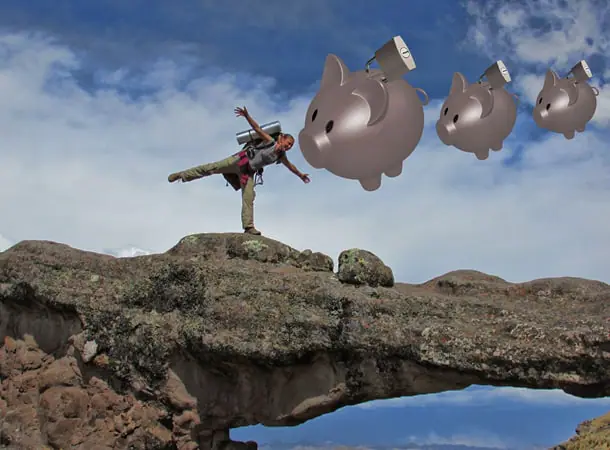
I mean that where our safety is at stake, there should be no room for saving money! And as life shows time and again, very often it is precisely in this area—when planning our trips and buying equipment for them—that we look for savings.
From the film and from the very sad experiences of its protagonist, it is worth remembering at least two things:
First:
Do not skimp on safety. If something is important, more comfortable, much lighter, more stable, pay any price for it. Whether it's good sunglasses, a GPS, a flashlight, ropes, clothing, or even an ordinary knife, do not buy cheap equipment that is unreliable in action. It is better to wait a month or two longer to save up the extra money for good-quality gear than to buy something that may be either completely useless on the trail or useful to a much lesser extent than it should be. Therefore, before buying travel equipment, consider twice what you are buying! Remember that cheaper equipment can bring you more harm than good, and with it greater losses than savings.
Second:
Always leave a message for one, and preferably several people, about your travel plan—where you are currently going and for how many days. Nowadays we increasingly travel solo, constantly moving from place to place. With family or friends we often talk only once every few days, because either there is no internet or too little time. And yet, in the meantime, a lot can happen. Hopefully not! But it is worth thinking rationally. And it is always worth sending an email or calling to say where you are currently staying and what you plan to do. Moreover, if you are staying in a hostel/hotel and going on a trek, especially if you are going alone, inform the staff. The protagonist of 127 Hours seemed to forget this basic rule, and it almost cost him his life. And yet, communicating your travel plans to anyone costs nothing!
Things worth having with you on every trip!
Among the extremely important things worth having with you on every trip (besides other items/equipment that must be taken depending on the nature of the trip and where you are going and for how long), it is certainly worth having:
- A knife/good pocket knife. Here, Swiss Army knives probably have no equal. I had one, but unfortunately only until I first landed in Lima, specifically until I went to the airport to travel to Cusco. Having forgotten to put the knife in my main luggage, I placed it in my carry-on, so it ended up being inspected. The knife shared the fate of thousands of other knives and similar items—it went into a large container standing right next to the security guards. It was a sad sight, especially since the knife was not among the cheapest. The only consolation is that I had and still have a spare one, just a bit smaller.
- A functional, very bright headlamp—with new batteries (depending on how long you are going for—possibly with spare batteries)
- A minimal first-aid kit, with plasters, gauze, hydrogen peroxide, elastic bandage, and headache medication. I have quite good experience in this matter and never part with my pocket first-aid kit. It has helped me more than once. There were several situations where, without its contents, I would have had quite serious problems.
- Water and snacks. Better to take a little more than less, especially if you don't know the route and are not fully aware of how long the trip will take.
You can read about what to generally take on a trip to Peru, among others, in the article "What to take on a trip to Peru? Packing smart".
The film 127 Hours – worth watching or not?
For me, this film is worth seeing for many reasons. It is very instructive, for everyone, and especially in my opinion for all those who go on various trips, often forgetting the basic safety rules. I think it will prompt more than one person to reflect, because against the backdrop of travel events, it raises very important topics, certainly very close to many of us, and at the same time, ones that many of us often forget.
Besides, I generally love travel films, and even more those based on true stories, so if you have similar tastes, I think you will like it too.