“Mujer Montaña” is a non-profit organization, founded in 2013 by Denys Sanjinés (Andean Secrets – Bolivia) and Griselda Moreno (Makalu Team – Argentina). The organizers believe and are deeply convinced that regardless of how old you are, it is never too late to gain new experiences, commune with nature, and take on increasingly serious challenges within it. I sign on to all of this one hundred percent, which is why I took part with great pleasure in the third edition of the Mujer Montaña project, which took place in Peru in 2015. Details from our 7-day mountain expedition as part of this extraordinary project, just below.
The Mujer Montaña project – it is a unique initiative

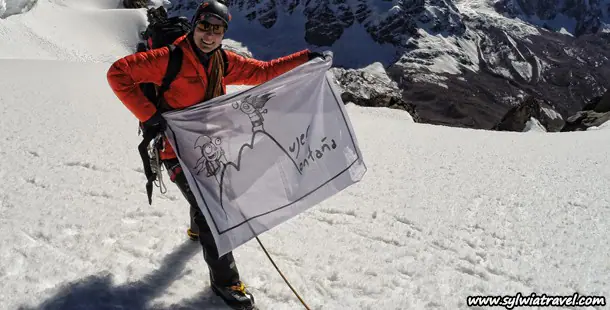
At the summit of Campa, Cordillera Vilcanota, Peru – 5,500 m above sea level
But before I talk about what happened during the whole week, a few words about the Mujer Montaña organization itself
The organization’s goal is primarily to promote and spread high-mountain climbing, alpinism, and extreme sports among women of different ages and with different experience, as well as to exchange experiences not only in sports but also in culture. Regardless of current knowledge and experience in the broadly understood mountain field, Mujer Montaña is open to everyone, and above all to women who either already practice this type of sport or dream of practicing it. This is about, among other things, integrating; exchanging experiences; training at both basic and advanced levels in climbing courses, including ice climbing, as well as in first aid and high-mountain rescue; and also about searching for new climbing routes and tourist trails.
As part of achieving the above goals, the organizers, or rather the female organizers of Mujer Montaña, carry out international meetings and projects in various countries of Latin America. Projects of varying difficulty levels, in various conditions, of course always connected with the mountains. Each edition of the project, which takes place annually, is held in a different part of Latin America, so as to involve as many female representatives as possible in the project and to spread the organization’s goals and ideas wherever possible.
Changing countries is also intended to gain and/or expand knowledge in climbing, alpinism, broadly understood extreme sports, as well as to gain new experiences which, depending on the country, can be and often are quite different. One must agree with the organizers of Mujer Montaña that each country means new mountain challenges, different climatic conditions, different styles and culture of practicing sports, including organizing expeditions. Just because you know how to move in the mountains in one country does not mean you will be able to move in the same way in the mountains of another country. That is why it is so important and valuable to get to know ever new climatic conditions, to practice in other corners of the world, at various levels of difficulty, and also to meet as many enthusiasts of this type of sport as possible, in order to learn together, further educate ourselves, exchange valuable experiences, and achieve ever new ones.
Mujer Montaña has its headquarters in Argentina and Bolivia, while the organization’s goal is to create its branches in other countries on the continent. Such a first branch/unit of Mujer Montaña has already been established in Peru, more precisely in Cusco.
Thanks to the fact that Mujer Montaña decided to organize the third edition of the project in the former Inca Empire, I could not miss the opportunity, and as soon as I learned about this plan, I quickly signed up for one of the expeditions.

Cordillera Vilcanota, trekking in the vicinity of, among others, the Campa and Ausangate peaks
My experiences with Mujer Montaña
As part of the third edition of Mujer Montaña in Peru 2015, a total of 3 independent expeditions are being organized. Each one different, with a different level of difficulty, in different climatic conditions. I had the opportunity to participate in the second stage of this third edition, namely in a 7-day mountain expedition in the Cordillera Vilcanota.

Cordillera Vilcanota, morning trekking
The Cordillera Vilcanota is a mountain range located in southeastern Peru, in the Eastern Cordillera (Central Andes). It stretches for about 250 km between the Yanatil and Yavero river valleys (Paucartambo). It is located in my favorite region, namely the Cusco region. The most recognizable peak in this mountain range is Ausangate – the fourth largest mountain in Peru. The Cordillera Vilcanota is a beautiful part of the Andes with magnificent mountain trails; easier and more difficult peaks to conquer; a place that is in many respects exceptional, unique, and definitely worth visiting.

Resting at the summit of Campa, Cordillera Vilcanota, Peru – 5,500 m above sea level
It was here, as part of the Mujer Montaña project, that our group of more than 40 people, representing 13 different countries (including three from Europe: Poland – me :-), Spain, and Norway), spent 7 wonderful days full of impressions, emotions, and intensive practice.
Seven Days in the Cordillera Vilcanota
We started the expedition from my favorite place, i.e. from the tiny village of Pacchanta, located right at the foot of Ausangate. First, there was a division of things into those we had to transport to the camp on our own backs and those, more technical, essential for high-altitude climbing, which were to travel on the backs of hired horses.

The beginning of the expedition, the village of Pacchanta and the view of the Ausangate peak
After dealing with that part, we set off at full speed on our way. This one – very charming, provided us with increasingly beautiful views with every step, and experiences too. A lot of experiences, because the team is strictly international. Also an extraordinary number of topics for conversation.

Trekking towards Campa base camp
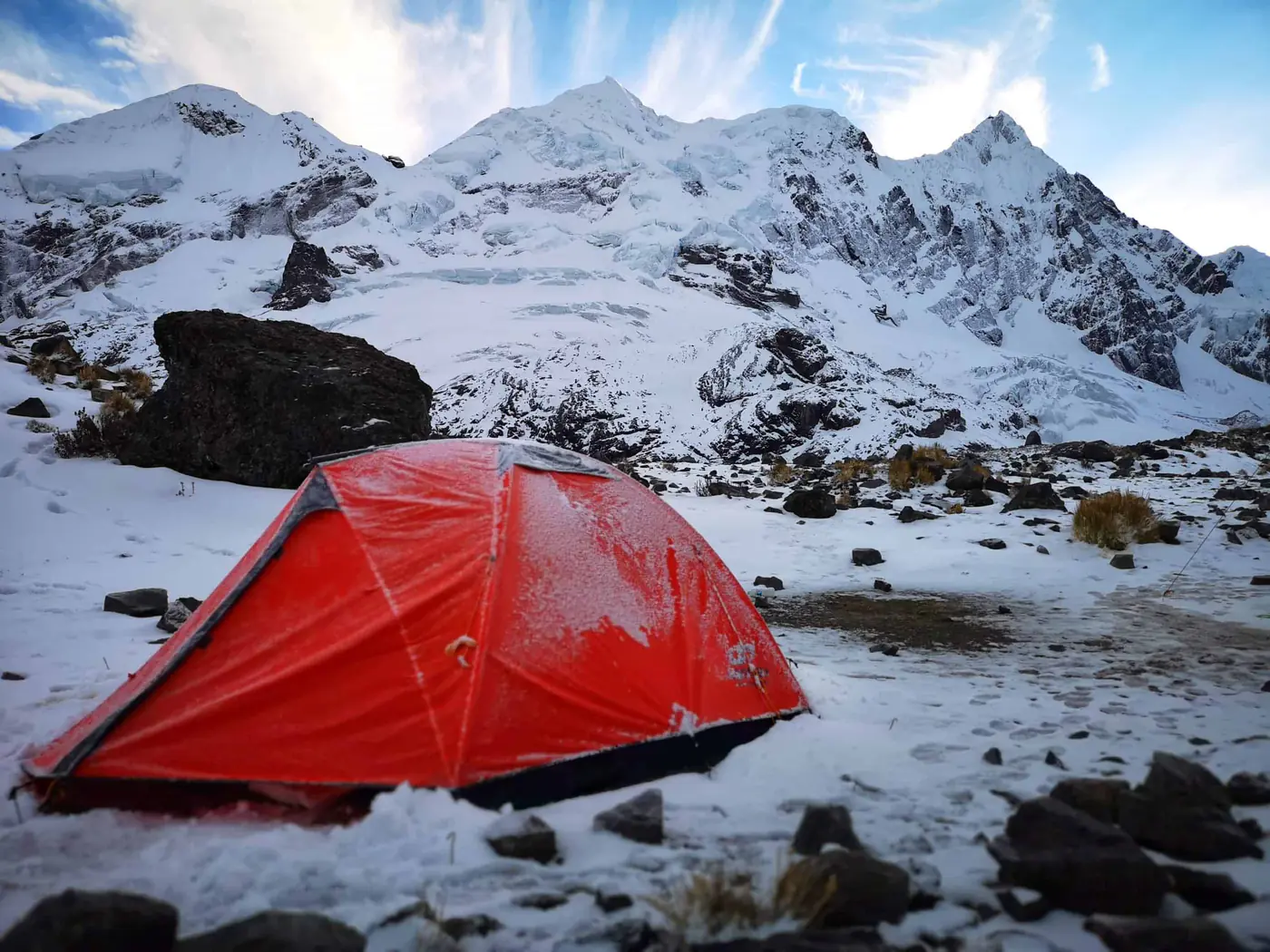
After about three hours, the first people began to appear at the camp (Campa base), which became our new home for the whole week. Finding a spot for one's tent, constructing a mountain shelter, lunch, and the first instructions for the individual days :-).

Campa base, Cordillera Vilcanota, Peru
The following days were filled to the brim with practice. First, a morning trekking, about an hour and a half long, to the foot of the glacier, then several hours of practice and exchange of experiences in the field of working on ice, high-altitude climbing, rescue systems, and everything connected with independent work during mountain expeditions. And then the return, that is, over an hour-long trekking back to the camp, each time with a head full of new knowledge. It's not hard to guess that after 5 days of such expeditions, our heads were considerably "heavier" with that knowledge ;-).

Training in high-altitude climbing, Cordillera Vilcanota, Peru
I admit here that all the lessons were extremely valuable and extremely important, not only for those who want to become independent and organize expeditions of this type without a mountain guide, but for everyone, to know what high-altitude climbing is about and what possibilities, dangers, etc. it carries.

Training in high-altitude climbing, Cordillera Vilcanota, Peru
During the expedition we had the pleasure of working with very experienced instructors who generously shared their knowledge, practice, and skills. It was an extraordinary experience for me. Like nowhere else, I learned very useful and extremely helpful techniques here. I also consolidated my existing knowledge on the subject. All of this not only gives a bit more confidence, but above all "addicts" and pushes one – to learn more and to dig even deeper into the subject.
The five-day training ultimately resulted in the fact that on the fifth night I decided to climb the Campa peak – 5,500 m above sea level – independently. Independently, meaning without being roped to a mountain guide, but only with another participant of the project. And that was an amazing, completely new experience for me. Perhaps the beginning of my independent climbing expeditions? As of today I don't know yet, but who knows…

On the way to the Campa peak, Cordillera Vilcanota, Peru
On the way to the summit of Campa (5500 m above sea level). A test of independence!
Campa or Q’ampa/J’ampa is a mountain that is generally easy to conquer. Apart from, of course, the altitude, which can prevent reaching it, there are no particular difficulties here – at least when climbing it from the standard side. All you need is good physical fitness, as in any mountain expedition also mental fitness, proper acclimatization, and the chances of scrambling up to the summit are practically one hundred percent.

Campa summit in Cordillera Vilcanota, Peru – from a distance
The situation looks somewhat different when climbing Campa independently, without a guide who, if necessary, will help, build a protection system, etc. Then even such a simple mountain becomes a kind of challenge.
Such a challenge faced the participants of the 2nd stage of the third edition of Mujer Montaña, and therefore also me. After several days of practice, it was time for the test, that is, for an independent climb to the summit. This is one of the aims of the Mujer Montaña project. The idea here is to train participants in such a way that they are able to become independent in the field of high-mountain climbing. And I must admit that at this basic level, this goal was achieved during our 7-day expedition. Participants in groups of two or three conquered the mountain independently. The instructors, meanwhile, circulated in the area and, at our request, checked how we were coping with this independence, offering advice and help if needed.

On the way to the summit of Campa, Cordillera Vilcanota, Peru
I conquered Campa with a friend from Peru. Neither of us had previously attempted high, snow-covered summits without an experienced guide, so it was an extremely interesting experience for us. It was also a good lesson in trust, which we had to grant each other from moment to moment. Because the mountain may be easy to conquer, but as mountains go, you shouldn't trust any of them and simply cannot. You have to be prepared for various situations, because nature is unpredictable. And since we were trying our strength independently, and not with a guide, the burden of covering the route as safely as possible rested on us. It was also us who had to "haul" the ropes and equipment necessary either to undertake a possible rescue operation or to build a protection system. So it was incomparably harder, because this time, for the first time, it was us, and not the guide, who had to have those mountain "gadgets" with us. It also cannot be denied that ultimately we had incomparably greater satisfaction from reaching the summit than in the case of conquering the earlier mountains.
As for the Campa mountain itself, it must be admitted that it is different from those on which I had previously been able to set foot. The first difference: the summit is constructed in such a way that there is relatively a lot of space there, which of course also translates into safety. Quite a few people could also fit on it. Moreover, just before its conquest, the mountain has two small walls to overcome, which altogether can be overcome with little risk even without protection (assuming we are dealing with a person who has experience in the matter). Of course, as part of the practice, on the final approach we used a certain belay system. I spent much more time on the summit of Campa than on others. Firstly, the mountain made this possible with its dimensions, secondly, the weather was very favorable to us, thirdly, the impressions were quite significant, so we wanted to enjoy it all for as long as possible.
And those views… One wanted to admire them endlessly…

On the summit of Campa, Cordillera Vilcanota, Peru – 5500 m above sea level
Ultimately, as is the case with conquering any summit, the time comes to leave it. Satisfied and rested, we began the return to base, which we reached around 14:00. It was our last day in the mountain environment, and also the last night before returning to Cusco.
Time to return to urban reality
On the seventh day, happy and fulfilled, we went to Pacchanta, where some celebrated the end of the 7-day second stage of Mujer Montaña in the hot springs, while others, from the shore, over chats, admired the majestic Ausangate mountain for the last time.

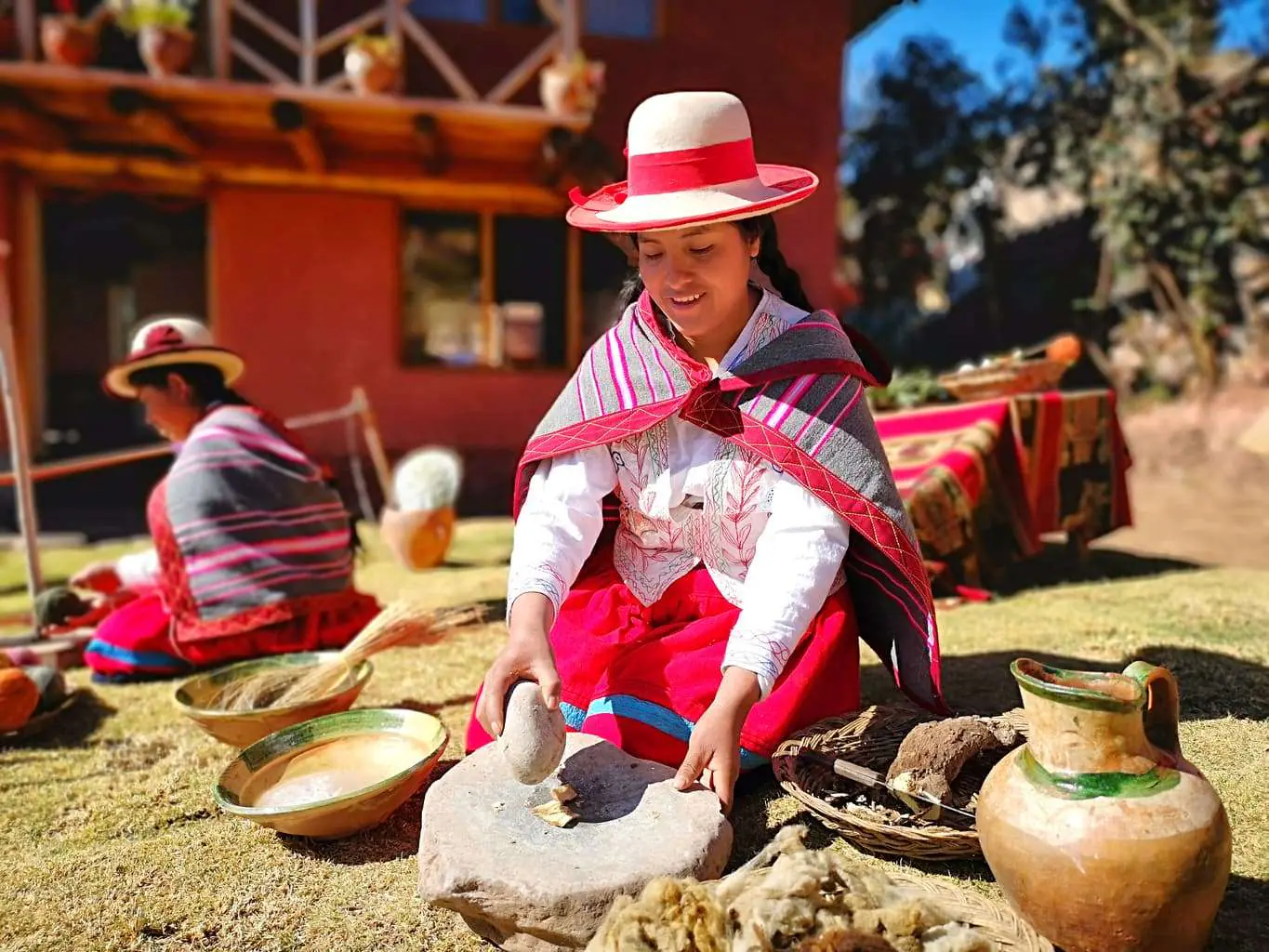
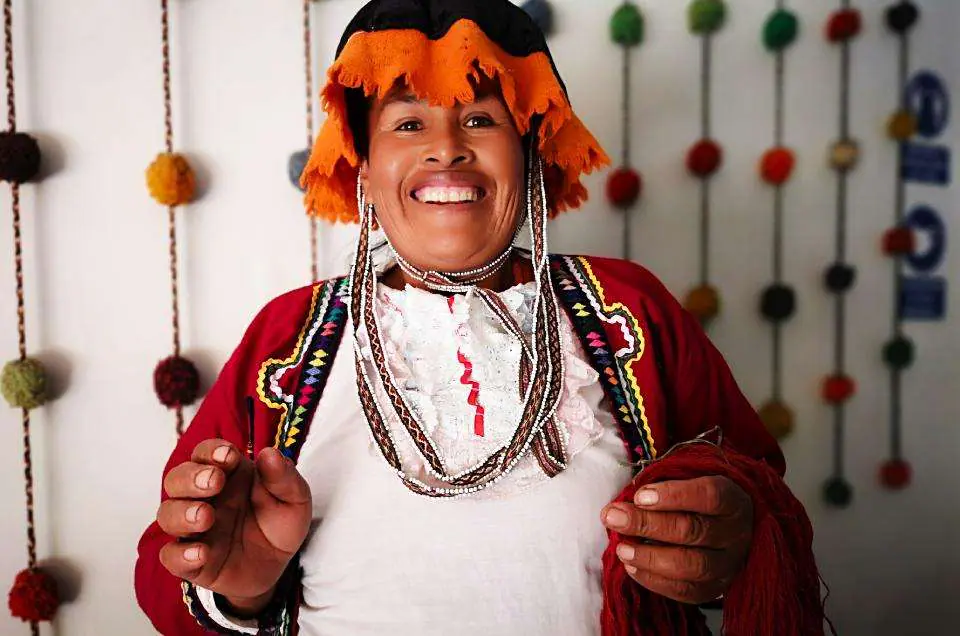
Handmade textiles, community from the village of Pacchanta, Peru
Finally, in the evening we returned to urban everyday life, that is, to Cusco.

The end of the expedition as part of the Mujer Montaña project, Pacchanta, Peru
We ended the entire expedition with a joint dinner, the distribution of diplomas, and dancing :-).

Diploma of participation in the second stage of Mujer Montaña, Peru 2015
A report from the Mujer Montaña Mexico 2018 edition can be found in the article "Discovering Mexico as part of the next edition of Mujer Montaña". We recommend it!