
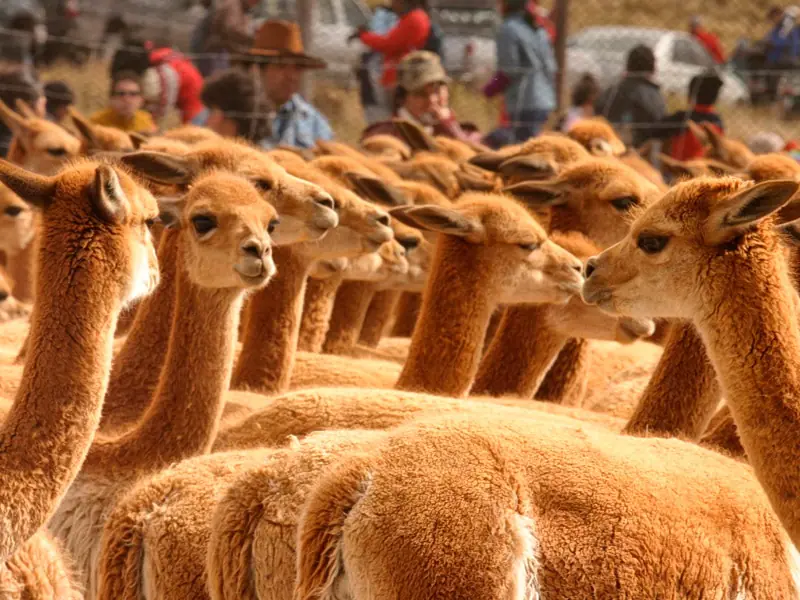
The El Chaccu festival in Peru is becoming more and more popular every year. Just a few years ago, it was celebrated exclusively by the local communities living in the areas where vicuñas are found. In recent years, however, the number of participants has been growing. All thanks to tourists (both domestic and foreign) who are increasingly eager to take part in Peruvian ceremonies unique on a global scale. These include, among others, the "El Chaccu" (chaku) festival. And you? Would you like to experience such an attraction? See what interesting things might await you during this ceremony!

Vicuñas waiting to be shorn during el chaccu in Peru
El Chaccu in Peru: past and present
The pre-Hispanic tradition of vicuña hunting is still upheld today. It is mainly practiced in the regions of Huancavelica, Ayacucho, Puno, Apurimac, Cusco, and Arequipa. How does it work in practice? Details below.
During the Inca Empire, El Chaccu was held every 3 or 4 years, solely by official decree of the ruler. Illegal poaching was punishable by death. Vicuñas were then considered sacred animals. Clothing made from their wool could only be worn by Inca rulers and their closest aristocratic circle.
Currently, the ceremonies take place annually in various parts of Peru. Poaching is punishable by 3 to 5 years in prison. The most famous and largest El Chaccu festivals take place in the Pampas Galeras National Reserve in July. The reserve was established in 1967 in the Lucanas region, Ayacucho. It is home to the largest concentration of these exceptionally valuable camelids.
But for tourists who want to participate in el chaccu, it will be easier to come to the Arequipa area. Here, at least several such events are organized every year.
Why are el chaccu festivals organized?
The vicuña hunting festivals are held for specific purposes. It is about obtaining wool – one of the most expensive and highest quality in the world! These beautiful animals have it. Since vicuñas are wild, a way had to be found to catch them for shearing without harming them and then release them back into the wild. As in Inca times, this method consists of several stages. First, the herd of vicuñas is driven into one place. To achieve this, dozens or sometimes hundreds of people go into the field, positioning themselves at small intervals, forming a kind of circle. Participants of el chaccu usually hold decorated ropes, ribbons, or carry various instruments that make noise. Everyone moves forward in a strictly defined direction.
Once the goal is reached and the vicuñas are in a large corral, the next stage begins: prayers, followed by shearing.

Colorful ribbons held by participants during the festival
Everything is done under supervision, because vicuñas are protected and cannot be hunted and deprived of their valuable woolen coat without proper permission.
Below is a shaman offering prayers during one of the el chaccu festivals that our SylwiaTravel team attended.
Below we present videos about the festival, enjoy watching 🙂
El Chaccu – Pampa Galeras – Ayacucho
El Chaccu – Pampa Galeras – Ayacucho, part 2
Vicuñas are said to be the wild gold of Peru. No wonder. A kilogram of wool from this animal costs several hundred dollars. They are currently the most valuable animals in the former Inca country, thanks to which local Andean people have a chance for a source of income. If you want to read about vicuñas, be sure to check out our article Vicuñas from Peru are true wild gold.